
Varshaphal Explained: Your Annual Chart, Solar Return and Muntha
Learn how a Varshaphal chart is timed, calculate Muntha with a simple example, and combine annual astrology with your natal chart and dashas.
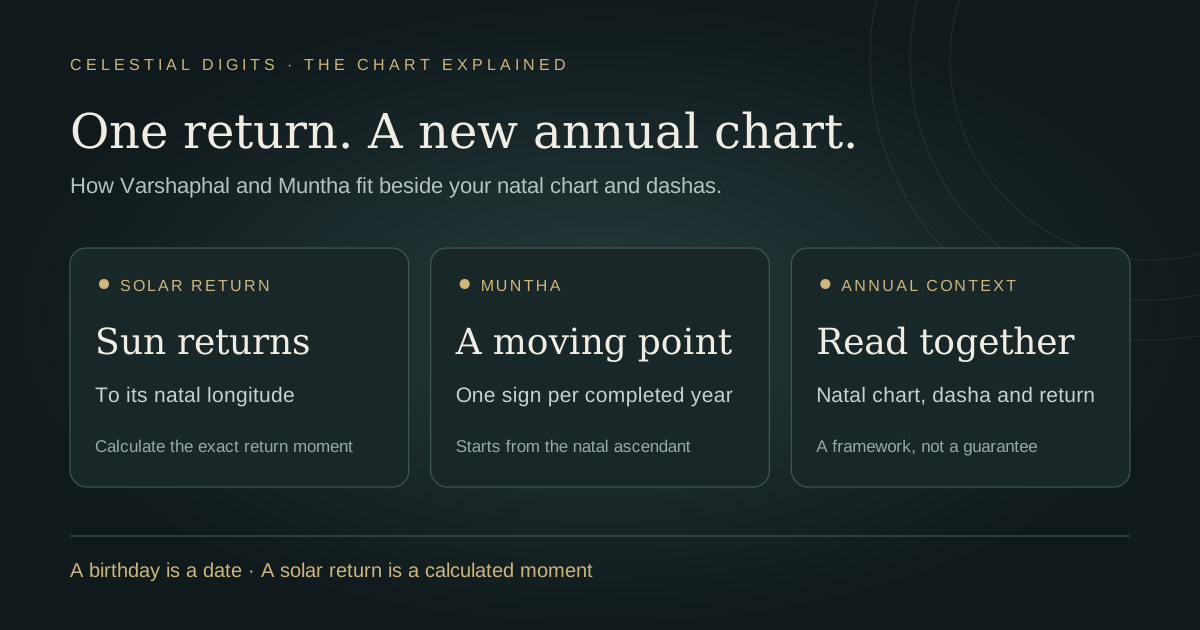
Your natal chart stays anchored to your birth. A Varshaphal chart is calculated for an annual return of the Sun to its birth longitude and is traditionally used to examine the year ahead.
It does not begin automatically at midnight on your birthday, and it does not replace your natal chart. It adds an annual frame: a fresh ascendant, planetary positions at the return, and techniques such as Muntha and annual periods.
The useful starting question is precise: which return moment and which location produced this annual chart? Without those settings, two reports may look different before interpretation even begins.
What does Varshaphal mean?#
Varshaphal, also written Varshaphala, concerns the results or indications of a year. Much of its specialist technique belongs to the Tajika tradition, whose history includes the adaptation of Perso-Arabic astrology into Sanskrit astrology.
It is therefore misleading to describe every annual technique as simply a copy of natal Parashari rules. Tajika has its own aspects, configurations, strength methods and annual timing practices. Martin Gansten's edition of Balabhadra's Hayanaratna, The Jewel of Annual Astrology, documents that wider framework.
You do not need to master every technique before understanding what the annual chart is showing. You do need to keep its vocabulary separate from your natal report.
Varsha Pravesh: the moment the annual chart begins#
The return moment is called Varsha Pravesh. Imagine the natal Sun at exactly 2°15′ Gemini in the sidereal zodiac. The calculation searches near the anniversary for the moment the Sun again reaches that longitude under the selected sidereal convention.
The date can fall near the civil birthday without matching its clock time. Leap years, timezone display and the return convention can all affect the date and time you see.
Celestial Digits currently calculates its annual chart using a Lahiri sidereal solar return and the birth location. That is the convention to match when comparing its output. Software using a tropical return or a different location can produce a different annual ascendant without necessarily having an arithmetic error.
The Sun's return is one instant worldwide. The chosen location determines the horizon and house geometry at that instant. Converting the instant to another timezone changes its displayed clock time; relocating the chart changes the location used for the chart itself. These are different operations.
What is Muntha?#
At sign level, Muntha advances one sign for each completed year of life, beginning from the natal ascendant at birth. It is a calculated progression, not an additional planet in the sky.
The progression wraps around after twelve signs. At the twelfth annual return, its sign comes back to the natal ascendant sign. That recurrence does not make every twelfth year identical: the annual ascendant and planetary positions are different.
Worked example: Virgo ascendant at the 29th return#
Start with Virgo at age zero. Advance 29 signs, which is equivalent to advancing five after removing two full twelve-sign cycles:
| Completed years | Muntha sign |
|---|---|
| 0 | Virgo |
| 1 | Libra |
| 2 | Scorpio |
| 3 | Sagittarius |
| 4 | Capricorn |
| 5 or 29 | Aquarius |
So Muntha is Aquarius, whose ordinary sign lord is Saturn. But its annual house still depends on the annual ascendant.
If the annual ascendant is Taurus, Aquarius is the tenth whole-sign house. If the annual ascendant is Cancer, Aquarius is the eighth. The Muntha sign has stayed the same; the annual house reference has changed.
The example follows the sign-level progression shown in our report. More elaborate traditions also discuss degrees and further refinements; do not assume a sign-level label represents all of them.
Muntha lord is not automatically the year lord#
The Muntha lord rules the sign occupied by Muntha. The year lord, often called Varshesha, is selected through the annual method's own conditions.
Those roles can fall to the same planet, but they are not synonyms. Similarly, an annual ascendant lord is not necessarily the natal ascendant lord.
When a report mentions “Saturn” in several places, preserve the role beside the name. Otherwise a discussion of Saturn as Muntha lord can accidentally become a claim about a Saturn mahadasha that is not running.
How to combine the annual chart with natal timing#
Use a single, concrete question. “What should I pay attention to in my work this year?” is more useful than demanding a verdict on whether the entire year is good or bad.
- Establish the natal context and the relevant houses and lords.
- Note the current natal mahadasha and antardasha.
- Check the annual ascendant, relevant annual houses, Muntha and its lord.
- Consider the annual techniques actually included in the report.
- Add transits as a further timing layer rather than changing methods whenever a result is inconvenient.
For example, an annual emphasis on the tenth house can be explored through work and responsibility. It does not prove a promotion. A person studying, caring for family or seeking employment has a different practical context from a person already managing a team.
Annual periods are not your natal mahadasha#
Mudda dasha is an annual timing system used in many Varshaphal reports. Its shorter periods should not be read as if your lifelong Vimshottari sequence has suddenly restarted.
Always label the system and its date range when copying a period into a prompt or discussing it with an astrologer. “Venus period” without “natal antardasha” or “annual Mudda period” is incomplete information.
Our guide to reading dasha and transit together gives a useful foundation before adding this annual layer.
A practical comparison checklist#
Before comparing two annual reports, record the target return year, exact return instant, zodiac and ayanamsa, chart location, house convention and completed-age count used for Muntha. Compare those facts before interpreting different outcomes.
Open your birth chart and choose Varshaphal to explore the annual report. Use its displayed calculation details rather than treating the civil birthday as the return moment.
An annual chart can organise a traditional reading and prompt useful reflection. It cannot guarantee an event, replace evidence about your circumstances or establish that a difficult year is unavoidable.
Source note: the historical overview draws on Gansten's edition of the Hayanaratna. The worked example is original; product-specific calculation statements were checked against Celestial Digits' current annual-chart implementation.
Related Posts
Does Moving Abroad Change Your Birth Chart?
Separate your original birth chart from relocation techniques, current-location calculations and annual charts before changing your saved birth details.

Jupiter in Cancer 2026–2027 for Aquarius Ascendant
Jupiter in Cancer for Aquarius ascendant: sixth-house work, second and eleventh lordship, resources, career aspects and the 2027 return.

Jupiter in Cancer 2026–2027 for Aries Ascendant
Jupiter in Cancer for Aries ascendant: fourth-house home and education themes, ninth and twelfth lordship, career aspects and the 2027 return.
A little more perspective.
Keep discussions respectful. No harassment, hate, sexual content or spam. Comments are reviewed before publication. Report concerns from a comment menu, or contact [email protected].
Checking your session…