
Pitra Dosha: Real Indicators, Common Myths, and Grounded Remedies
What Pitra Dosha actually means in classical Jyotish: real chart indicators, honest confidence levels, common myths, and grounded, respectful remedies.
Few phrases in Jyotish are used to frighten people as efficiently as Pitra Dosha — the so-called "curse of the ancestors". A stranger glances at a chart, announces the dosha, and quotes a price for the fix. That routine has very little to do with what the tradition actually says.
The honest one-sentence version: Pitra Dosha is a set of chart patterns suggesting unresolved themes connected to the father's line, lineage duties, and inherited family patterns — most classically, afflictions to the Sun, the Moon, and the 9th house and its lord by Rahu, Ketu, or Saturn.
Read that way, it is neither a curse nor a billing opportunity. It is a diagnostic flag: look at this person's relationship with their elders, their lineage, and the patterns their family keeps repeating. This article covers what the classical texts actually flag, how much confidence each combination deserves, what Pitra Dosha is not, and remedies that respect both the tradition and your intelligence.
Where the Idea Comes From#
The concept sits at the meeting point of two streams.
The ritual stream comes from the Dharmashastra and Purana literature: the living owe shraddha (memorial rites) and tarpan (water offerings) to departed ancestors — the pitrs. Neglect of these duties is said to leave the lineage's business unfinished.
The chart stream comes from Jyotish's natural significators:
- The Sun is the karaka (significator) of the father and the paternal line.
- The Moon is the karaka of the mother and the maternal line.
- The 9th house is the house of the father, dharma, lineage merit, and ancestral blessing — the "purva punya" flowing down to you.
- Rahu and Ketu, the karmic nodes, and Saturn, the planet of debts and delay, are the classic afflicting agents.
When the afflicting agents lean hard on the lineage significators, tradition reads it as ancestral karma pressing on the native. Later compilations (and especially modern popular literature) systematised this into "Pitra Dosha". You will not find one crisp definition in Parashara; you will find the ingredients, which later astrologers assembled in different ways. That is worth knowing, because it explains why every website lists a different set of rules.
The Main Combinations, with Honest Confidence Levels#
Here are the combinations most commonly claimed as Pitra Dosha, ranked by how seriously working astrologers treat them. No single combination "gives" anything by itself — dignity, aspects, and the rest of the chart always moderate the result.
Strong, classically grounded indicators#
- Sun conjunct Rahu or Ketu, especially in the 9th or 5th house. The father-significator eclipsed by a node is the single most cited signature. Behaviourally it often shows as a strained, absent, or complicated father relationship, or confusion about paternal identity and authority.
- 9th lord conjunct or closely aspected by Rahu, Ketu, or Saturn, particularly when also weak by dignity (debilitated, combust, or in the 6th, 8th, or 12th). The house of lineage merit runs through a compromised manager.
- Sun–Saturn close conjunction or mutual aspect afflicting the 9th house axis. Saturn (duty, debt, the old) pressing on the Sun (father) classically reads as heaviness inherited from the paternal line — obligations more than blessings.
Moderate indicators — meaningful mainly in combination#
- Moon afflicted by both nodes or by Saturn while the 4th or 9th house is also stressed: the maternal-line version of the same logic. On its own, an afflicted Moon is far too common to call a dosha; alongside a stressed 9th house it strengthens the lineage reading. (For the nodes' general behaviour, see Rahu and Ketu, the shadow planets.)
- Rahu or Ketu placed in the 9th house with additional affliction to the 9th lord or Sun. A node alone in the 9th is roughly one person in six — it needs reinforcement before it means anything.
- Multiple malefics (Saturn, Mars, nodes) clustering in the 9th with no benefic aspect, so the house has pressure and no relief.
Weak or folkloric claims — treat with skepticism#
- "Any planet in the 9th house causes Pitra Dosha." False on its face; Jupiter or a strong 9th-lord in the 9th is a blessing, not a curse.
- "Sun in the 8th or 12th house = Pitra Dosha." These are placements with their own meanings; alone they indicate nothing ancestral.
- Blanket rules like "Rahu in 1st/4th/8th means ancestral curse" that appear in pamphlets but in no classical source with that meaning.
A fair summary: the more independent afflictions converge on the Sun–9th-house–9th-lord cluster, the more seriously the pattern deserves attention. One touch is noise. Three converging touches are a theme.
How to Check It in Your Chart#
- Locate the Sun. Note its sign, house, dignity, and whether Rahu, Ketu, or Saturn conjoin or aspect it within a close orb.
- Examine the 9th house from lagna. Which planets occupy it? Is it hemmed between malefics? Does any benefic aspect relieve it?
- Assess the 9th lord. Its dignity, house placement (6th, 8th, 12th are harder seats), and any nodal or Saturn contact.
- Repeat briefly for the Moon and 4th house if the maternal line is the question.
- Count the convergence. Zero or one affliction: no case. Two: a tendency worth watching. Three or more independent afflictions on the cluster: a genuine chart theme.
- Check the Moon chart too — if the same houses are clean from the Moon, downgrade the reading.
What Pitra Dosha Is NOT#
This section matters as much as the combinations.
- It is not every planet in the 9th house. The 9th is also the house of fortune, gurus, and higher learning. Plenty of judges, professors, and genuinely lucky people have occupied 9th houses.
- It is not a death sentence on career, marriage, or children. Popular articles attribute practically every misfortune to Pitra Dosha — delayed marriage, job loss, childlessness, illness. A signature that explains everything explains nothing. Marriage delay, for instance, has its own well-defined factors (houses, dashas, and delay logic here).
- It is not detectable from your name, birth number, or a phone consultation without your chart. If someone diagnoses it without examining the Sun, Moon, and 9th house, they are selling, not reading.
- It is not fixed by paying a stranger a large fee. Classical shraddha is performed by the family, for the family, usually by the eldest son or the family's own tradition-holders. Outsourcing your ancestors to the highest-bidding intermediary has no textual basis.
- It is not a moral judgement on your ancestors. The tradition's own frame is unfinished duty and unresolved patterns — debts and habits, not villains. Fear-selling inverts this into "your family is cursed", which is neither classical nor useful.
The Behavioural Reading: Repeating Family Patterns#
Here is the most practical modern use of the signature, and the one that requires no belief in curses.
Charts with a heavily afflicted Sun–9th cluster very often belong to people whose families repeat a pattern across generations: estrangement between fathers and sons, property disputes that resurface every generation, a lineage of men who die early or leave, addiction cycles, or a family story that is never spoken about directly. The native frequently finds themselves either re-enacting the pattern or appointed — without ever being asked — as the one who must resolve it.
Typical real-life textures:
- the native manages the father's affairs from a young age, reversing the parent-child roles
- inherited property exists but is entangled, disputed, or emotionally radioactive
- the native feels an unexplained obligation to "fix" the family, or a strong urge to cut off from it entirely
- authority figures at work trigger reactions sized for someone else — usually the father
Read this way, Pitra Dosha is less "the ancestors are angry" and more "the lineage's unfinished emotional and material business tends to land on this person's desk". Dashas of the afflicted Sun, the 9th lord, or the involved node are typically when that desk gets busiest.
Timing: When the Pattern Activates#
The pattern is dormant most of the time. Expect it to become a live topic during:
- Mahadasha or antardasha of the afflicted Sun, the 9th lord, Rahu, or Ketu — whichever planets form the signature
- Saturn's transit over the natal Sun or through the 9th house, which often coincides with father's health matters, inheritance questions, or duty falling due
- Rahu–Ketu transits across the natal Sun–Moon axis or the 3rd–9th axis (node transits by house)
- Pitru Paksha, the annual fortnight of ancestor rites, when families traditionally attend to exactly this department of life
These windows are for attention and completion of duties — not for dread.
Common Mistakes to Avoid#
- Diagnosing from one placement. Sun with Ketu in a chart that is otherwise strong in the 9th is a nuance, not a dosha.
- Ignoring dignity. An exalted 9th lord aspected by Saturn is a disciplined fortune, not a cursed one.
- Letting the label do the analysis. Once "Pitra Dosha" is announced, people stop reading the chart. Keep asking which specific significator is afflicted and what department of life it actually rules.
- Confusing correlation with mechanism. A troubled father relationship in the biography plus Sun–Rahu in the chart is a consistent picture; it does not license predictions of doom.
- Buying remedies sized to your fear rather than the chart. The cost of a remedy has no relationship to its effectiveness.
- Skipping the Moon-chart cross-check. If the 9th from the Moon and its lord are clean, the ancestral reading weakens considerably.
Grounded, Respectful Remedies#
The traditional remedies are humble, family-based, and mostly free. That alone tells you what to think of expensive rescue packages.
- Shraddha and tarpan under your own family tradition. If your family observes annual rites or Pitru Paksha offerings, participate properly rather than delegating. If you are unsure of procedure, ask your family's own purohit or elders — this is lineage work, done in the lineage's way, under qualified guidance.
- Serve the living elders first. The tradition is blunt on this: honouring living parents and grandparents outranks ritual for the departed. Regular calls, medical care, settling their paperwork, recording their stories — this is pitra work in its most direct form.
- Finish the family's unfinished business where you reasonably can. Resolve the stalled property matter, pay the old debt, make the apology, restore the broken contact. The dosha's signature is incompletion; its remedy is completion.
- Document the family pattern. Write down what actually repeats across three generations — health, money, marriage, temperament. Seeing the pattern on paper is often the moment it stops running you. This pairs naturally with honest self-work or counselling where the pattern is heavy.
- Charity in the ancestors' name — feeding people, supporting elders' homes, or education for children in need — given quietly, sized to your means.
- Sun-strengthening routine: early sunrise exposure, Surya namaskar, and offering water at dawn are traditional, harmless, and behaviourally anchoring. Any specific mantra practice (such as Aditya Hridaya) or ritual beyond family custom should be taken up under qualified guidance, not from a search result.
Notice what is absent: fear, urgency, and a price tag. A remedy-seller who cannot explain which significator is afflicted and why their remedy addresses it deserves your polite exit. For the wider logic of what remedies can and cannot do, see how Vedic remedies actually work.
Related Vedic Reads#
- Rahu and Ketu: Understanding the Shadow Planets
- Vedic Astrology Remedies: What Works and Why
- Kemadruma Yoga: Myths vs Classical Rules
- Mangal Dosha: How to Check It and What Actually Helps
- Rahu-Ketu Transit Through the Houses
Final Take#
Pitra Dosha, read honestly, is a convergence of afflictions on the Sun, Moon, and 9th-house cluster — a flag pointing at lineage duties and repeating family patterns, not a curse requiring an expensive exorcism. Check the convergence, watch the relevant dashas, do the humble family-facing work, and refuse to be sold fear about your own ancestors.
For personalized guidance on this topic with your exact data, get a detailed Vedic Reading.
Related Posts
Kaal Sarp Dosha: Types, Myths, and What Actually Matters
Clear guide to Kaal Sarp Dosha: exact definition, all 12 types from Anant to Sheshnag, partial vs complete formation, false alarms, and sane remedies.
Debilitated Planets: Functional Strength, Cancellation, and Remedy Strategy
Practical Vedic astrology guide with chart checks, timing filters, and usable upaya for clear decisions.
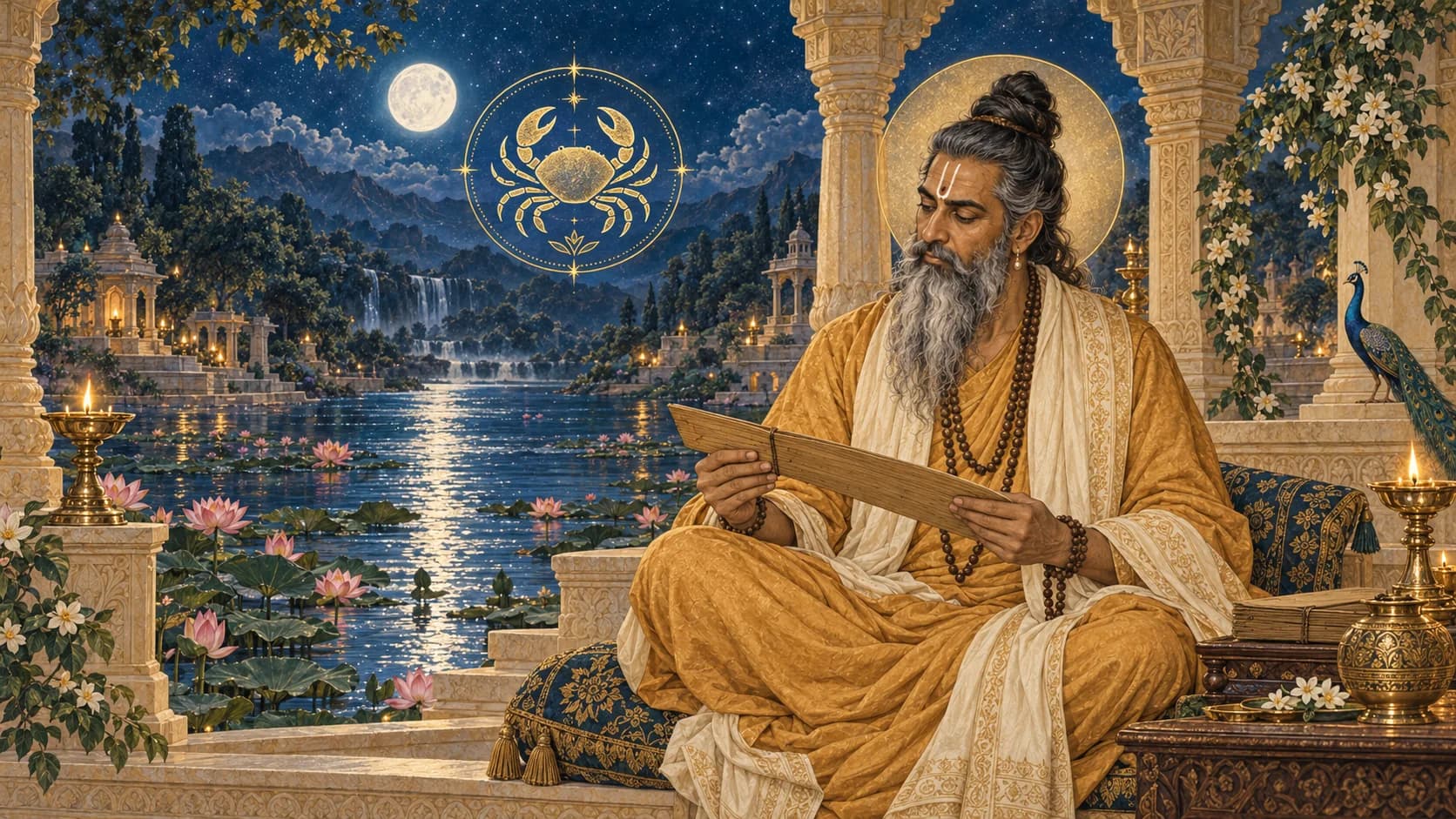
Jupiter in Cancer 2026–2027: Dates and All 12 Ascendants
Jupiter in Cancer from June 2, 2026: verified dates, the 2027 return and detailed guides for all 12 ascendants, with lordships and aspects.
A little more perspective.
Keep discussions respectful. No harassment, hate, sexual content or spam. Comments are reviewed before publication. Report concerns from a comment menu, or contact [email protected].
Checking your session…